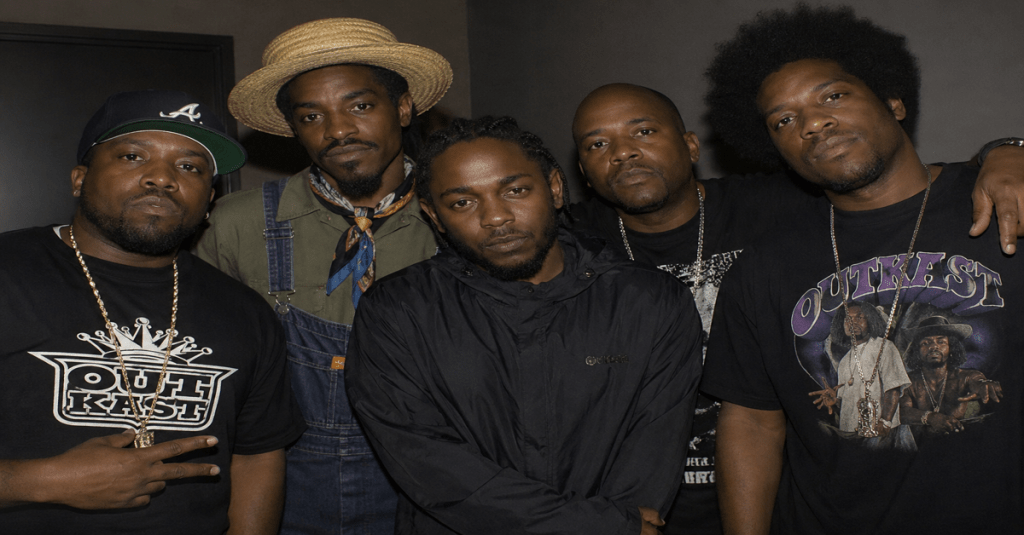
There’s a difference between hearing an album and understanding it—and sometimes that understanding only shows up years later, when your ears have caught up to the music.
Revisiting Aquemini by Outkast recently, what stood out wasn’t just how good it is (that part’s already settled), but how familiar certain moments felt in a completely new way. Not nostalgic—predictive. Like hearing something that hadn’t fully revealed its reach yet.
And almost immediately, two tracks reframed the entire experience: “Aquemini” and “Synthesizer.”
Starting with “Aquemini,” the title track begins with a relaxed Southern drawl, but then it changes. The delivery becomes tighter and the phrasing clearer. “Who does this remind me of?” I wonder. There’s a precision in the looseness, suggesting that every line is intentional, even though it sounds casual, like “Swimming Pools.” That’s when it hits me. Kendrick.
This doesn’t just sound like Outkast in 1998. It sounds like Kendrick Lamar before Kendrick Lamar. Not in theme but in the mechanics of the voice itself. The elasticity and the gravel. “Even the sun goes down, heroes eventually die/Horoscopes often lie and sometimes, “Y.”‘
Then “Synthesizer” follows, and the connection deepens.
Here, the delivery gets more direct—faster, sharper, almost striking in its impact. There’s a sense of urgency in the rhythm, the kind that not only follows the beat but reshapes it. Listening now, it’s hard not to notice Kendrick’s style: how he condenses meaning into brief moments, and how he can speed up and slow down within a single verse while keeping clarity and effect.
It’s the kind of resemblance that goes beyond influence as a talking point—it feels structural. “Synthesizer, microwave me (cybersites)/Give me a drug so I can make seven babies (are horny tonight).” And while Kendrick hasn’t often pointed directly to Aquemini in interviews, he’s come close enough that the lineage starts to fill itself in. He’s been explicit about his admiration for André 3000, once placing him among his top-tier lyricists and saying:
“André 3000, he’s one of the greatest… his wordplay, his concepts…”
In another discussion about lyrical inspiration, Kendrick included André as one of the artists who influenced his writing—focusing on permission rather than imitation. Permission to explore, to be abstract while staying focused, and to allow the delivery to carry meaning just as much as the words. It’s clear to me now.
There’s also a broader Southern thread Kendrick has acknowledged. In discussing the scope of hip-hop’s evolution, he’s pointed to how artists from the South expanded what rap could sound like—how they brought melody, experimentation, and a different kind of narrative pacing into the genre. That blueprint runs straight through Outkast, and Aquemini sits right at the center of it.
Critics have long connected those dots more directly. Retrospectives often frame Aquemini as a precursor to the kind of genre-blending, narrative-driven hip-hop Kendrick would later refine—particularly on albums like good kid, m.A.A.d city and To Pimp a Butterfly. The comparison isn’t about copying sounds; it’s about shared architecture: dense storytelling, shifting tones, voices that function as instruments as much as conveyors of meaning.
Listening now, that architecture stands out. What’s notable isn’t just that Kendrick might have drawn inspiration from Outkast—it’s how clearly that influence appears when you revisit the original with a fresh perspective, especially in the nuances.
It’s not the kind of connection that announces itself the first time through. But once you hear it, you can’t unhear it. And suddenly, Aquemini doesn’t just sound like a classic. It sounds like a beginning. Get at me, ya’ll!
 And your ears shall hear...
Leave a comment